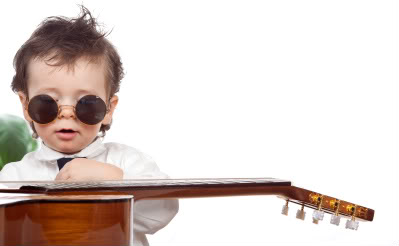
Top Ten Tips to Get Kids Playing and Loving Music
May 14, 2009 by Kitchen Table Medicine
Filed under Guest Posts, Kitchen Sink, Music, Pediatrics
 by Jeremy Dion
1. Keep it fun – nothings shuts down one’s inherent musical expression like a drill sergeant for a “teacher.”
Goof around, laugh, and know when enough is enough. Sometimes effective practice is done before the egg timer goes off.
2. Play music in the home – make sure you make time to play your favorite music, your child’s favorite music, and new music.
Take the time to explain to them why you love a particular piece of music. They may get it, they may not. But at least they begin to understand that music has unimaginable depth.
3. Sing with and to your child– normalize this mode of expression to combat the “American Idol” message that only polished, perfect singers should sing.
4. Explore rhythm – Our first experience is of our mother’s rhythmic heartbeat while in the womb. We ARE rhythm – our own heartbeat, our breathing, our walking, speaking, circulation, etc. Drum, dance, use pots and pans, etc.
5. Praise their playing, rather than criticizing their “wrong notes.” Blessed is the child who sings what she feels with abandon rather than the child with perfect pitch who is too afraid of criticism to utter a note.
6. Find a music teacher who really connects with your child. Like psychotherapy, the relationship is 90% of the battle. If your child likes the teacher (for reasons other than his or her musical prowess), the practice comes a lot easier.
7. Dance. With reckless joy, dance. With and for your child. Give them the experience that expression, no matter how “ridiculous” it may be labeled in other circles, is fun, free, and healthy.
8. Improvise, improvise, improvise: instead of spending all the time learning songs by rote, stretch. Put up pictures instead of music on the stand, and play a “thunderstorm” on the piano, or “a newborn child.” Take chances and risks, stretching the psyche’s ability to express.
So often we hear, “I can’t sing,” or “I can’t play.” Don’t believe it! It’s just that our cultural standards of what it means to sing and play have been hijacked by popular media. Everyone can play, everyone can sing. Embrace it, and pass it along to your child. In other words, what is life other than a daily improvisation?!
9. Attend live performances. In addition to supporting the arts, we should put our money where our mouths are. Don’t expect them to love their first showing of “The Nutcracker” during the holidays. Take them to local performances, open mics, anything that will help them understand that this mode of expression (playing an instrument, singing) is shared by many, and touches all.
10. Let go of expectation. If you are the one in a million parent who has a musical prodigy for a child, so be it. Nothing will stop him or her from following that path. For the rest of us, the goals and expectations around our child and his or her musical endeavors are best organized around expression, fun, creativity, and joy. When I use musical expression as a way to connect with (instead of to critique) my child, we are rarely more connected.
To purchase Jeremy Dion’s CD’s you can visit www.JeremyDion.com. You can also add Jeremy as a Myspace friend, load his songs to your Myspace profile, and follow Jeremy’s tour updates on Facebook.
 Dr. Nicole Sundene, NMD is a licensed Naturopathic Medical Doctor at Fountain Hills Naturopathic Medicine 16719 E Palisades Blvd, Suite 205, Fountain Hills, AZ 85268.
She believes we should utilize natural medicines to treat the root cause of disease rather than just treating symptoms, as symptoms are a message of imbalance sent from the body and will persist until they are properly addressed.
For appointments please visit http://FHnaturopathic.com for more information about Naturopathic Medicine services.
©KitchenTableMedicine.com, LLC ™
The Healing Power of Music: An Interview with Jeremy Dion
November 11, 2008 by Dr. Nicole Sundene
Filed under Counseling, Guest Posts, Kitchen Sink, Music
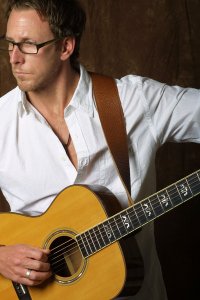 Hi Kitchen Table Medicine readers! Ever wonder about the healing power of music?
Well, I have invited therapist and musician Jeremy Dion to the kitchen table to discuss the therapeutic benefits of music.
I am delighted to host this interview because it is wonderful to see health care professionals use their creative talents to further help people. Please welcome to the kitchen table therapist and musician Jeremy Dion…
Jeremy, what is your professional background?
I make a living as a psychotherapist in private practice, in Frisco, Colorado. I work mainly with kids doing play therapy, and teens, but I also work with couples, adults, and families. Adolescents were the last group of people I wanted to work with as I made my way through graduate school, as I keenly remembered the type of teenager I was. Yet after graduation I took a job with a Wilderness Therapy program, and would up providing therapy to the roughest and toughest kids on the block. I learned how to reach and care for kids who weren’t getting that from many other sources, and it flipped a switch in me.
Now, working with the “trouble makers” is one of my specialties. I have degrees in music therapy and counseling psychology, but somewhere along the way I decided to focus my musical efforts on my own songwriting and performing, rather than using my specific training as a music therapist. I am in the midst of the transition to making my living as a professional musician.
How long have you been playing music?
As long as I can remember. I grew up playing the piano, and singing to myself. I was in the Middle School choir, but so was everyone else it seemed. Later, I began singing in earnest with the encouragement of Issaquah High School vocal teacher Lavonne Watson. It was during that time that I really developed the internal awareness that I could sing, and sing pretty well. Up until that point it was mostly family members giving me positive feedback on my singing, but they can’t be trusted to be too objective.
So I sang all through High School, performed in the school musicals, etc. But It wasn’t until I was a freshman at U.C. Berkeley that I picked up the guitar and began to write my own songs. Since that time, making sense of the world through songwriting has always been a natural outlet.
I enjoy the performance aspect of being a musician, of course, but even if I wasn’t performing, I would still be writing songs and playing the guitar. Corny as it may sound, sometimes I feel like I might explode if I didn’t write songs, play guitar, and sing. It has become so much a part of me at this point that I would be literally lost without it.
What are the therapeutic benefits of playing and listening to music?
Oh man, how much space have you got for this interview? Pick an aspect of being alive, and therein lies a musical benefits. Whether we look at physiology involving things like heart rate, measurable stress level, breathing patterns, neuro-synaptic activity, or the less tangible things like motivation, emotional awareness, emotional processing, memory recollection, etc. music has been demonstrated again and again to bolster health.
Furthermore, spirituality and music have been paired long before recorded history. As a species we resonate with music as a means of worship, as a way of connecting more deeply with the divine both internally and externally. Music therapy as a field has been around for generations, but sadly still fights an uphill battle for recognition in our western medical models. Yet we all seem to know intrinsically that music adds innumerable dimensions to the human experience, and we use this knowledge in unique ways. We use music purposefully to match our mood, to conjure memories, to shift our mood, and to feel more deeply.
In addition, with the advances in fields like quantum physics, we are reminded again and again that everything is vibrating, from the largest knowables in the universe to the most microscopic sub-atomic particles, we are vibrations. In a very real sense, everything we know and everything we are is music.
How has your professional training in psychology been of benefit to your career as a musician?
First of all, I went through a very unique graduate program at Naropa University in Boulder. As a three year program, it focuses on one’s internal process as much as (if not more than) the academic information. We had years of training in meditation and mindfulness, were required to participate in our own therapy, and were encouraged to become painfully familiar with our own habit patterns and nuances before we could hope to be of benefit to someone and theirs.
In that sense, my graduate training reminded me again and again to go inward, to dig in the dirt, plumb the depths, and get in touch. I must say, this type of program does not suit everyone. Yet it was perfect for me, and encouraged me to learn more about myself in those three years than in the previous twenty three combined.
From this depth of understanding, most of my songs are born. As a result, my lyrics are intensely personal to me, and releasing this first CD was akin to publishing my personal diary. Thankfully, people have been resonnating with music. In addition, my career as a psychotherapist has continued this path of understanding, of seeing aspects of myself in my clients’ process and heightening my awareness about my own personality, my own idiosyncrasies, and my own divinity. All of this informs my writing and my performances.
Who is the musician that inspires you the most?
Paul Simon. His brilliance shines through on so many levels both musically and lyrically. He has a way about him that I very much admire - a way of speaking simply, but giving the sense that he is really getting at so much more.
I have never been accused of under-analyzing anything, and I’m sure I read much more into his music than others might, but his music consistently inspires me the most. My own journey as a songwriter has been to become more transparent in my writing. I used to write very poetically but in a way that was wide open to interpretation, and often left the listener feeling detached from the music.
That was purposeful at the time, because I wasn’t ready to open up and get too clear about my internal world. That has been changing, and as my songs become more true and clear, they have been reaching a broader audience. I credit Paul Simon with some of this.
What kinds of positive messages do you promote through your music?
Elvis Costello wrote, “What’s so funny about peace, love, and understanding?” My music, I suppose, promotes those things in such an unabashed way that sometimes I just have to laugh at myself. As a described earlier, my music is about me.; it is about being alive on the planet; it is about love and loss, anger and resentment, beauty and laughter, joy and pain.
Others may read into it many other things, and that is welcome. That’s what music is about - being able to personalize it and make sense of it the way it adds up to you. But in the end these songs are about me and the things I think about and feel about. To me, that’s the positive message: go within.
Share with us a specific example of lyrics intended to make a difference.
They all have made a difference. I don’t mean that in a “I can save the world” sort of pompous way. I mean in the way that I am different for having written them, having worked through them, having sung them again and again. As I said before, if I didn’t have this outlet, the world would make less sense to me and I might explode out of sheer overwhelm. If I had to pick a lyric to share, it would be from “Back Breaking Wall,” and was intended to extoll the virtue of looking within:
“Every now and then I feel one more step away from being here
Even though in earnest how I try to get back to you, my dear
Resurrecting all these ancient bones under centuries of soil
The sanctity of self-reflection separates the water from the oil”
Where are you currently on tour?
Mostly in Colorado - Denver, Boulder, and the mountain cities around Breckenridge.
What is your favorite stress management tip?
Exercise, meditation, and some sort of creative outlet. I don’t care if it’s painting, drawing, poetry, journaling, music, dance, scrapbooking, etc. Just create.
Thanks Jeremy for sharing your creative and professional wisdom with us!
To purchase Jeremy Dion’s CD’s you can visit www.JeremyDion.com. You can also add Jeremy as a Myspace friend, load his songs to your Myspace profile, and follow Jeremy’s tour updates on Facebook.
I am always interviewing various health care providers, contact us if you have a unique health related story to share at the kitchen table.
Dr. Nicole Sundene, NMD is a licensed Naturopathic Medical Doctor at Fountain Hills Naturopathic Medicine 16719 E Palisades Blvd, Suite 205, Fountain Hills, AZ 85268.She believes we should utilize natural medicines to treat the root cause of disease rather than just treating symptoms, as symptoms are a message of imbalance sent from the body and will persist until they are properly addressed.
For appointments please visit http://FHnaturopathic.com for more information about Naturopathic Medicine services.
©KitchenTableMedicine.com, LLC ™