Best Organic Cabernet 2008
December 18, 2008 by Dr. Nicole Sundene
Filed under Best, Kitchen Sink, Organic

 The Bonterra Cabernet Sauvignon Mendocino County 2006 is simply a delightful, delicious organic red wine.
Most oenophiles will agree that the organic wine industry is pretty limited, young, and newly developing. I would actually rate some of the organic red wines I’ve tasted as worse than the worst boxed wine. The exorbitant price just further leaves a bad taste.
It is important to buy organic wine because grapes are on the “Dirty Dozen” of most pesticide ridden foods. Grapes are the 9th most toxic produce item.
From a biochemical standpoint we are concentrating and extracting lipid soluble toxins with the wine making process.
From a health standpoint, we want to lesson the total chemical burden on the liver by eliminating avoidable pesticides and added sulfites. Wine naturally contains sulfites, but organic wine does not have additional sulfites which translates in to less of a “red wine hangover.”
This is why you can go to Europe and taste many different red wines without the headache, as Italy and France do not allow for additional sulfites in wine making unless they are due for export to America.
Organic red wine is a great way to “cheat the system” for those of you that are always asking me for healthy short cuts. If you aren’t going to give up your red wine for the new year, then just go organic with it!
The best way to maximize the anti-aging benefits from the resveratrol in red wine is to reduce the total toxic burden of the beverage. Organic red wine provides all the power of resveratrol without all the sulfites, pesticides, and other needless garbage that pollutes our system.
Makes plenty of sense, but still it is tough to find an organic wine that is both tasty and affordable.
I was happy to learn from the Safeway wine guy that this Bonterra organic cab scored a whopping 88 points which is pretty significant for an organic red!
Wine writer David Lawrason reviewed Bonterra’s 2006 organic cab as, “a lovely evenness, with bright berry fruit, a touch of Cabernet, green bean and tobacco, and moderate toast and clove. Mid-weight and nicely balanced, with fine tannin. Very good length. Enjoy over the next four years.”
Wine spectator James Laube describes this organic red as, “Supple, elegant and polished, with ripe, fleshy plum, black cherry, mineral, spice and light cedary oak flavors that are well-proportioned, gaining length. Drink now through 2011.”
Be sure you are picking up Bonterra’s 2006 organic cab, as our kitchen table tasters did not particularly care for Bonerra’s merlot.
Since I am not a fan of Cabernet I invited my team of product tasters over to help me with an unbiased review, and they were pleased to highly recommend this organic red.
“Jammy and delicious!”
“Very smooth…”
“I could drink a glass of this every day, and for fifteen bucks a bottle I think I will.”
“Yummy! This is a great cab.”
And of course my favorite comment, “This is guilt free wine at it’s finest!”
I am happy to report that although I typically don’t care for cab’s I agreed with my fellow tasters and found it to be smooth, jammy, sweet, light, and delicious. Most cab’s are too tart for my pallet, but this one was just right.
I was also pleased about the price, for just $12 on sale, this 88 point organic red is definitely a great wine to load up on when sales hit, and you can always just grab a case through your local wine dealer to get a further price break. A perfect bottle of organic wine makes for the perfect holiday party gift. If you have a friend that is a oenophile the rare find of a delicious organic red will absolutely make the perfect gift…and their livers will of course thank you too!
Bonterra is typically available at Safeway, PCC, Whole Foods, and other natural markets that feature organic products.
~Dr. Nicole
If you have an organic product you would like tested at the kitchen table simply contact us.
 Dr. Nicole Sundene, NMD is a licensed Naturopathic Medical Doctor at Fountain Hills Naturopathic Medicine 16719 E Palisades Blvd, Suite 205, Fountain Hills, AZ 85268.
She believes we should utilize natural medicines to treat the root cause of disease rather than just treating symptoms, as symptoms are a message of imbalance sent from the body and will persist until they are properly addressed.
For appointments please visit http://FHnaturopathic.com for more information about Naturopathic Medicine services.
©KitchenTableMedicine.com, LLC ™
Why We Should Like Bugs and Worms
November 21, 2008 by Dr. Nicole Sundene
Filed under Diet Tips, Environmental Medicine, Fruits and Veggies, Gardening, Guest Posts, Kitchen Sink, Organic, Whole Foods Diet
 Do you like bugs and worms?
Well if you do, you can feel vindicated by today’s topic, and if you don’t you may change your mind after reading today’s guest post. This is also a great teaching topic to share with your children. Won’t you sound so smart next time you are outside with your kids looking at bugs in the garden? Teach them about the microscopic bugs at work in our soil, and the important agricultural role they play.
Remember, even the Hobo Spider deserves his place in the environment, and we just need to respectfully avoid encounters without going on spider killing rampages.
Please enjoy part II in the series of “Organic vs. Commercially Farmed Food” by Stephen Cox.
Within any healthy soil are billions upon billions of microorganisms. Some microorganisms live in a symbiotic relationship with plants. For example a certain type of microorganism actually puts out a protective net around the plants roots in the soil and the net is covered with a type of glue.
When, along comes a microscopic parasitic worm, it gets caught in the net. Other microorganisms, which also live symbiotically with the plant punch a hole in the invader’s body, liquefy its organs, which are the most nutrient dense part, and feed that to the plant.
With commercially farmed produce the fields in which the foods you eat are grown, have been repeatedly sprayed with chemical toxins that kill the microorganisms in the soil. It’s not dissimilar to chemical warfare because pesticides, fungicides, herbicides and other chemicals resemble neurotoxins. And the food you’re eating is growing in an environment where tons of this toxic waste is being dumped. It would be naive to believe that it is not somehow finding its way into our food, our water and our general environment.
With little to no microorganism in the soil to support plant life commercial farmers turn to chemical fertilizers. Have you ever wondered why it is we hear on the news that someone used fertilizer to blow something up? That is because the chemical fertilizer the food we’re eating and using very closely resembles gunpowder.
After World War II ended the governments of the day were left with all these munitions factories. So they spent millions of dollars (at the time it was a colossal amount of money) to convince farmers that if they weren’t using this stuff they were stupid. This was not a decision made with the best interests of health and wellbeing in mind. We’re talking straight economics.
Organic Solution
I grow some of my own veggies – carrot, spinach, broad bean, broccoli (incidentally a cup of broccoli contains 205% of the necessary daily intake of vitamin C and just 43 calories), rocket, onions, lettuce and herbs. All in a very small patch of land just 1 meter wide by 2 meters long. No pesticides. No chemical fertilizer.
Growing your own vegetables is a great way to boost your health and wellbeing. You’ll be giving the environment a helping hand at the same time. The vegetables you grow for yourself will not need to be harvested by large machinery and then shipped thousands of miles to a location where they may be kept in cold storage for weeks, even months. All those activities produce greenhouse gasses and contribute to global warming.
Growing your own food has other benefits.
It really grounds us and connects us as human animals with nature and our world.
Sometime we get disconnected and forget that we are part of something bigger. Disconnection can be a powerful source for unhappiness and depression.
The process of energy exchange as you plant, tend, water and harvest your own plants is something that really needs to be experienced.
It is a process of caring and love as opposed to rampant destruction for meaningless profit. You’ll gain joy just from watching the plants burst with life and growth in the sunshine after each rain.
Plants can take our stress much like they take our carbon dioxide. I find they help me to let go each afternoon when I spend a few moments giving them attention. It is in every sense a very holistic activity. If you have children I couldn’t imagine a better project you could enjoy with your children. Children are constantly learning and they can learn a lot from tending a garden.
Organic Conclusion
Life feeds on life. There is a constant cycling of energy transference. First the microorganisms support plant life. Plants are consumed by herbivores and omnivores. Carnivores and omnivores in turn consume the herbivores. All produce waste (even plants drop leaves), which is food for the microorganisms, and all die which also feeds the microorganisms. And so, on it goes.
The disruption of the energy transference cycle at its very root, by killing microorganisms through commercial farming practice, means the life that feeds on the life before it cannot possible be naturally healthy. Human and animals that eat sick plans will not themselves be well. Nor humans that eat sick animals.
Do you still want to kill all those bugs and worms in your garden?
Read Part I of this series “Organic vs Commercially Farmed Food”

For more great articles by Stephen Cox you can visit BalancedExistence.com. Stephen is a graduate student in Australia. Read more articles by our featured writer, Stephen Cox.
Related Reading:
On organic farming and global warming
Organic farms produce same yields as conventional farms
Can organic farming feed the world?
The Top Eleven Easiest Foods to Grow
How to Get Your Kids to Eat More Vegetables
How to Make a Green Bean Teepee
Dr. Nicole Sundene, NMD is a licensed Naturopathic Medical Doctor at Fountain Hills Naturopathic Medicine 16719 E Palisades Blvd, Suite 205, Fountain Hills, AZ 85268.She believes we should utilize natural medicines to treat the root cause of disease rather than just treating symptoms, as symptoms are a message of imbalance sent from the body and will persist until they are properly addressed.
For appointments please visit http://FHnaturopathic.com for more information about Naturopathic Medicine services.
©KitchenTableMedicine.com, LLC ™
Why Buy Organic Coffee?
October 27, 2008 by Dr. Nicole Sundene
Filed under Caffeine, Coffee, Diet Tips, Kitchen Sink, Organic
 By
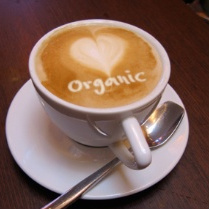
By What is organic coffee? Why would you buy organic coffee? Does it really matter? Is coffee good for you or bad for you? These are some of the things we will take a look at in this post.
Often we only hear about how coffee is bad for us, regardless of whether it is organic or not. Some might even say, “If coffee is bad for me anyway, why would I even bother to buy organic? While I’m certainly no doctor, there’s a principle that generally holds true: Too much of a good thing can be bad. Certainly research suggests that there are many health benefits of coffee. We will take a look at just a few of those before moving on to the subject of organic coffee.
Health Benefits of Drinking Coffee
While there are certainly other health benefits, WebMD list these benefits of drinking coffee:
- Decreased risk of type 2 diabetes (oddly enough, the more the better for this – so they say), colon cancer, Parkinson’s disease, cavities, and gallstones
- It can also increase your mood and help with headaches.
- “Overall, the research shows that coffee is far more healthful than it is harmful,” says Tomas DePaulis, PhD, research scientist at Vanderbilt University’s Institute for Coffee Studies.
- I’m sure Dr. Nicole could list some more for us, and she even gives us this great latte recipe: Perfect Dairy Free Latte, so there must be something good about coffee!
What is Organic Coffee?
As you would likely expect, organic coffee is coffee that is grown and processed without the use of artificial fertilizers, pesticides, herbicides or fungicides. Read on to learn the details.
Why Buy Organic Coffee? What are the Benefits?
1. Environmental benefits:
The agricultural techniques used to grow organic coffee need to work with the coffee plant’s natural preferences. Since coffee plants naturally love shade often organic coffee is shade grown and bird friendly. What does that mean exactly?
Shade grown and bird friendly coffee is, as you would expect, grown in the shade. Organic bird friendly coffee is grown under a canopy of rainforest trees. In these trees are numerous varieties of birds that feed off the insects under the canopy so there is not as great of a need for insecticides. Also, the tree roots prevent erosion and leaves from the trees help provide natural fertilizer so there is not a need for chemical fertilizer. In bird friendly coffee growing environments nature remains and the earth unharmed. The main problem with this process is that the natural process takes longer for the bean to mature than the processes which use chemicals.
2. Health benefits:
Coffee farms which use chemicals in the farming process do harvest more beans, but the chemicals strip the beans on the plants of many of their natural antioxidants and health benefits. Chemicals also strip the soil of its nutrients so there are less nutrients going into the plant and thus the bean. So if you want the real health benefits of coffee organic is the way to go. Plus, it helps take away the guilt! Go ahead and enjoy the benefits (in moderation of course).
3. Taste benefits:
If you’ve never had a cup of organic coffee, boy, are you in for a treat! Chemicals not only wash away the nutrients, but they also deplete the tastes. Coffee beans in an organic natural environment mature slowly allowing the taste to fully develop. The result is a rich smooth coffee. And yes, the smell is out of this world!
Top 3 Organic Coffee Favorites:
Dr. Nicole asked me to share my favorite organic coffees from my coffee shop. So I’ll end with my top 3 and why they are my favorites:
Organic Peruvian Decaf. This was the first Raven’s Brew Coffee© I ever tasted. It is very very smooth with just the right amount of sweetness and chocolate. I instantly became a Raven’s Brew organic coffee drinker because of my first sip of this one.
Organic Nayarit Decaf. This soon became my favorite decaf variety. Again, very smooth - silky like feel in the mouth. Hints of toffee with a light citric taste.
Organic Mahogany Sweets. Very smooth, sweet and chocolaty. (In my opinion, chocolate goes with just about everything.) Its description is “certified organic bliss.” I couldn’t say it any better.
Jennifer regularly blogs at Principles for Peace. The focus of her site is on inner peace and it is set in a bookstore/coffee shop environment. There you will find regular posts about obtaining inner peace, books recommended for inner peace and her coffee shop. Don’t forget to subscribe to her posts once you get there.
Check out these other great reads by Jennifer Abbott: “A Simple Formula with a Big Life Impact”, “How to Stop Negative Thinking”, “The Art of Peaceful Bill Paying”
Dr. Nicole Sundene, NMD is a licensed Naturopathic Medical Doctor at Fountain Hills Naturopathic Medicine 16719 E Palisades Blvd, Suite 205, Fountain Hills, AZ 85268.She believes we should utilize natural medicines to treat the root cause of disease rather than just treating symptoms, as symptoms are a message of imbalance sent from the body and will persist until they are properly addressed.
For appointments please visit http://FHnaturopathic.com for more information about Naturopathic Medicine services.
©KitchenTableMedicine.com, LLC ™