Why We Should Like Bugs and Worms
November 21, 2008 by Dr. Nicole Sundene
Filed under Diet Tips, Environmental Medicine, Fruits and Veggies, Gardening, Guest Posts, Kitchen Sink, Organic, Whole Foods Diet
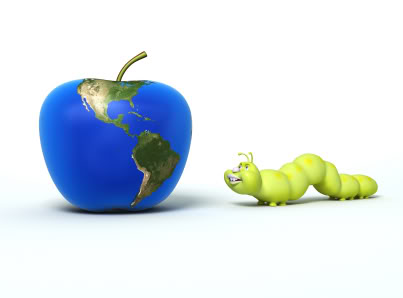
 Do you like bugs and worms?
Well if you do, you can feel vindicated by today’s topic, and if you don’t you may change your mind after reading today’s guest post. This is also a great teaching topic to share with your children. Won’t you sound so smart next time you are outside with your kids looking at bugs in the garden? Teach them about the microscopic bugs at work in our soil, and the important agricultural role they play.
Remember, even the Hobo Spider deserves his place in the environment, and we just need to respectfully avoid encounters without going on spider killing rampages.
Please enjoy part II in the series of “Organic vs. Commercially Farmed Food” by Stephen Cox.
Within any healthy soil are billions upon billions of microorganisms. Some microorganisms live in a symbiotic relationship with plants. For example a certain type of microorganism actually puts out a protective net around the plants roots in the soil and the net is covered with a type of glue.
When, along comes a microscopic parasitic worm, it gets caught in the net. Other microorganisms, which also live symbiotically with the plant punch a hole in the invader’s body, liquefy its organs, which are the most nutrient dense part, and feed that to the plant.
With commercially farmed produce the fields in which the foods you eat are grown, have been repeatedly sprayed with chemical toxins that kill the microorganisms in the soil. It’s not dissimilar to chemical warfare because pesticides, fungicides, herbicides and other chemicals resemble neurotoxins. And the food you’re eating is growing in an environment where tons of this toxic waste is being dumped. It would be naive to believe that it is not somehow finding its way into our food, our water and our general environment.
With little to no microorganism in the soil to support plant life commercial farmers turn to chemical fertilizers. Have you ever wondered why it is we hear on the news that someone used fertilizer to blow something up? That is because the chemical fertilizer the food we’re eating and using very closely resembles gunpowder.
After World War II ended the governments of the day were left with all these munitions factories. So they spent millions of dollars (at the time it was a colossal amount of money) to convince farmers that if they weren’t using this stuff they were stupid. This was not a decision made with the best interests of health and wellbeing in mind. We’re talking straight economics.
Organic Solution
I grow some of my own veggies – carrot, spinach, broad bean, broccoli (incidentally a cup of broccoli contains 205% of the necessary daily intake of vitamin C and just 43 calories), rocket, onions, lettuce and herbs. All in a very small patch of land just 1 meter wide by 2 meters long. No pesticides. No chemical fertilizer.
Growing your own vegetables is a great way to boost your health and wellbeing. You’ll be giving the environment a helping hand at the same time. The vegetables you grow for yourself will not need to be harvested by large machinery and then shipped thousands of miles to a location where they may be kept in cold storage for weeks, even months. All those activities produce greenhouse gasses and contribute to global warming.
Growing your own food has other benefits.
It really grounds us and connects us as human animals with nature and our world.
Sometime we get disconnected and forget that we are part of something bigger. Disconnection can be a powerful source for unhappiness and depression.
The process of energy exchange as you plant, tend, water and harvest your own plants is something that really needs to be experienced.
It is a process of caring and love as opposed to rampant destruction for meaningless profit. You’ll gain joy just from watching the plants burst with life and growth in the sunshine after each rain.
Plants can take our stress much like they take our carbon dioxide. I find they help me to let go each afternoon when I spend a few moments giving them attention. It is in every sense a very holistic activity. If you have children I couldn’t imagine a better project you could enjoy with your children. Children are constantly learning and they can learn a lot from tending a garden.
Organic Conclusion
Life feeds on life. There is a constant cycling of energy transference. First the microorganisms support plant life. Plants are consumed by herbivores and omnivores. Carnivores and omnivores in turn consume the herbivores. All produce waste (even plants drop leaves), which is food for the microorganisms, and all die which also feeds the microorganisms. And so, on it goes.
The disruption of the energy transference cycle at its very root, by killing microorganisms through commercial farming practice, means the life that feeds on the life before it cannot possible be naturally healthy. Human and animals that eat sick plans will not themselves be well. Nor humans that eat sick animals.
Do you still want to kill all those bugs and worms in your garden?
Read Part I of this series “Organic vs Commercially Farmed Food”
For more great articles by Stephen Cox you can visit BalancedExistence.com. Stephen is a graduate student in Australia. Read more articles by our featured writer, Stephen Cox.
Related Reading:
On organic farming and global warming
Organic farms produce same yields as conventional farms
Can organic farming feed the world?
The Top Eleven Easiest Foods to Grow
How to Get Your Kids to Eat More Vegetables
How to Make a Green Bean Teepee
 Dr. Nicole Sundene, NMD is a licensed Naturopathic Medical Doctor at Fountain Hills Naturopathic Medicine 16719 E Palisades Blvd, Suite 205, Fountain Hills, AZ 85268.
She believes we should utilize natural medicines to treat the root cause of disease rather than just treating symptoms, as symptoms are a message of imbalance sent from the body and will persist until they are properly addressed.
For appointments please visit http://FHnaturopathic.com for more information about Naturopathic Medicine services.
©KitchenTableMedicine.com, LLC ™