Let’s welcome to the kitchen table one of my favorite healing herbs…The Notorious Stinging Nettle.
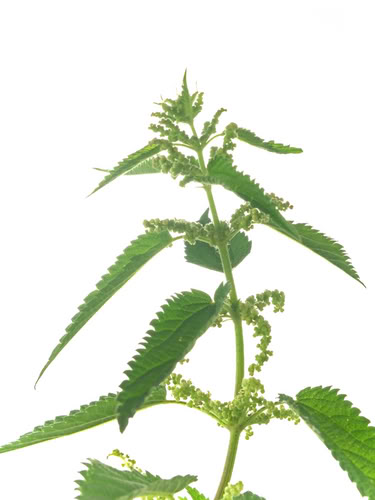
Now many of you may think nettles are a pesky weed, but that is simply an exception to the rule that “ignorance is bliss”. Wisely putting the weeds in your garden to good use after you pull them will serve your health well in the long run. Nettles are formerly referred to as Urtica diocia and fondly referred to by Native Americans as “Indian Spinach”. My hope at least is for those of you with seasonal allergies, arthritis and enlarged prostates to gain new appreciation, if not complete love and adoration for this fabulous plant.
The freeze dried herb can be used as an alternative to anti-histamines for allergy season. Nettle leaves are also known to be useful for arthritis, asthma, and edema; and are especially helpful in treating long term chronic illness as they are a nutritive plant rich in minerals such as potassium, calcium, and magnesium. The rich mineral content is thought to be the mechanism for reducing those painful night time leg cramps that usually respond well to water, calcium, magnesium and electrolytes. The root of the plant is found to be helpful for those with benign prostatic hypertrophy through an interaction with sex hormone binding globulin.
Fresh green plants such as nettles are high in chlorophyll. A molecule of chlorophyll closely resembles the hemoglobin in our red blood cells except that chlorophyll contains magnesium in it’s center ring instead of iron. Magnesium is important because most Americans on the Standard American Diet (SAD) are deficient in this essential mineral that aids in the relaxation of our muscles, detoxification of our livers, as well as over 200 other enzymatic pathways in our bodies. Green leafy vegetables and whole grains are both excellent sources of magnesium.
If you are ever lost or stranded in the woods you can technically eat nettles raw if you can get them past your lips without getting stung. The enzyme ptyelin in our saliva should denature the formic acid that causes the sting from the nettles. Now I am not recommending trying this, and have never tried this, and furthermore hope that I never will have to try this, nor do I hope you ever have to try this…but I am just saying it is always an option in an emergency situation.
When harvesting nettles be sure to wear gloves, although I have seen first hand a “Nettle Charmer” out there that has the ability to handle nettles without getting stung! Apparently the stinging acid only is released when the hairs of the plant are touched in a particular direction. Only harvest nettles that have not been sprayed with chemicals. Do not use nettles that are in the flowering stage as the flowers will cause an irritation to the urinary tract. The young leaves can be cooked with garlic and olive oil like spinach, steamed, stir fried, cooked in to a casserole, or made in to a tea or base for vegetable soup.
To make an herbal tea add at least 2 tablespoons of herb per cup of water to a covered soup pot and allow to simmer on the stove for about 15 minutes to an hour to extract the minerals. As this is a nutritive food several cups of this tea may be enjoyed liberally each day as this is a wonderful spring rejuvenator unless you are pregnant or on anti-coagulant “blood thinning” medications. If you have any health problems or use medications be sure to ALWAYS check with your doctor before using any herbs or alternative medicines. Give the nettles time to work in your body. Natural medicines and foods as medicines typically are much more gentle than most medications and so will take time to work their “magic” in your system. In the case of chronic illness, I usually give most things about three months before altering the treatment plan.
So which “weed” in your garden shall we make friends with next? I am thinking dandelions…
~Dr. Nicole
Resources: Herbal Medicine from the Heart of the Earth by Tilgner, Medical Herbalism by Hoffman, Plants of the Pacific Northwest by Pojar
Sign up to receive our FREE tri-weekly health coachings that include: Tips on diet and exercise, food as medicine, naturopathic answers to your latest medical questions, motivational discussions, herbal medicine making, superfood recipes, advice from our expert guests, and the latest in alternative medicine news! Remember all we can do is "try" to be healthier, whether it is every day or just three times a week. Click here to subscribe using an RSS reader.To receive our articles by email simply enter your email address below.
©Kitchen Table Medicine ™, LLC
Share This
Popularity: 26% [?]
Other Popular Posts:
- Are you suffering from a TERMINAL case of "The I Can'ts"? (43)
- McInflammation: Are You Really "Loving It"? (35)
- Can you give up dessert? (26)
- Tell Me What is in your Shopping Cart and I will Tell You What is Wrong with You... (25)
- Who are the Villains of the Kitchen Table? (25)
- Fish Oil vs Flax Oil? The Great Debate (23)
- What is Beauty? (22)
- Welcome (21)
- The Healing Power of Mexican Food (21)
- The 3 Day Depression Walk? (21)










 Dr. Nicole Sundene is the editor-in-chief of Kitchen Table Medicine. A graduate of Western Washington University for her undergraduate degree, and Bastyr University for her Naturopathic Physician degree, she also spent eight years working as a Medical Assistant for the world renowned leading institute Virginia Mason Medical Center. Throughout her education she had the invaluable opportunity to work side by side with many talented physicians specializing in Family Practice, Internal Medicine, Pediatrics, Otolaryngology, Cardiology, Dermatology, Urology, and Urgent Care. Her alternative medicine education along with training at Virginia Mason combined with the many years spent talking to patients as a telephone triage “nurse” have given her a diverse perspective on health care in America.
Nice Site layout for your blog. I am looking forward to reading more from you.
Tom Humes