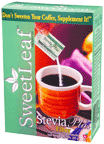
Wisdom Of The Ancients: Stevia Plus Fiber in the green packets pictured above seems to be the best Stevia I have come across. It is great because you can carry the packets in your purse and easily add a half a packet to your coffee or tea….it is very strong so be careful you may not even need that much! No, I am not affiliated with them, nor do I profit in any way if you pick some up at your local health food store or buy it online. I am just sharing what seems to work. If you have a favorite Stevia brand feel free to let me know in the comments.
The herb Stevia rebaudiana was named in honor of a Spanish botanist in 1556, P.J. Esteve. The plant was first cultivated in Paraguay and has been used as an herbal sweetener for centuries in South America by the Guarani Indians who have long used the herb to make a tea. Stevia leaves and twigs are commonly sold in local markets and pharmacies. Other names are ‘sweet leaf’ and ‘sweet herb’. An extract is also made of the leaves and flowers.
The sweet-tasting component in stevia is stevioside, which is 30 times sweeter than granulated table sugar, though some extracts are concentrated and can be up to 300 times sweeter than sugar. In Japan, the herb was approved in 1970. Since then, stevia extracts have come to make up 40% of the sweetener market. In 1991, the United States Food and Drug Administration placed an import ban on stevia, declaring that there was inadequate evidence to establish its safe use in food. In truth, the ban was mainly in response to pressure by the sugar industry and other companies making artificial sweeteners who would lose money if stevia were approved in the U.S. as a sweetener. (In 1988, Nutrasweet grossed 736 million dollars.) The ban was reversed late in 1995, although it’s still required to be sold as a nutritional supplement rather than as a sweetener.
A recent study in 1998, by the Southwest College of Naturopathic Medicine, showed no changes in blood glucose levels when stevia was consumed as a sweetener. In addition, there is evidence reported by the Hiroshima University School of Dentistry to show that stevia may help protect against dental caries/cavities, by suppressing dental bacteria growth. Japanese and Latin American scientists have discovered its value as a tonic and diuretic with the ability to combat mental and physical fatigue, to harmonize digestion, regulate blood pressure and assist in weight loss.
Culinary Uses
Powdered stevia leaf can be made into a simple extract by mixing one teaspoon in a cup of water and allowing it to soak overnight. The liquid extract is much better tasting and easier to use than the powdered form. It only takes a few drops to sweeten a cup of tea. It’s also delicious in yogurt, cereal and baked goods. Stevia’s sweetness is not affected by heat, though it will not caramelize like table sugar.
Nutritional Value Per 100 g Edible Portion: Calories 254, Protein 11.2 g, Fat 1.9 g, Fiber 15.2 g, Calcium 544 mg, Iron 3.9 mg, Magnesium 349 mg, Phosphorus 318 mg, Potassium 1,780 mg, Sodium 89.2 mg, Zinc trace, Manganese 14,700 mg, Beta Carotene 12,440 IU, Thiamine/B1 trace, Riboflavin/B2 trace, Niacin/B3 trace, Ascorbic Acid/C 11 mg.
Source: Bastyr students, edited by Dr. Nicole Sundene
Resources
1. Onstad, Dianne. Whole Foods Companion. 1996. Chelsea Green Publishing Co.
2. Omnivite Nutrition. “OmniBalance with Stevia” informational pamphlet.
To receive our news by email simply enter your email address below.
©Articles may be referenced, but not reproduced without direct written consent from Kitchen Table Medicine, LLC™. All content is under full protection by U.S. and international copyright laws.
Sincere thanks for sharing our preventative medicine website with your friends and family!
Popularity: 7% [?]
Other Popular Posts:
- Are you suffering from a TERMINAL case of "The I Can'ts"? (43)
- McInflammation: Are You Really "Loving It"? (36)
- Can you give up dessert? (26)
- Tell Me What is in your Shopping Cart and I will Tell You What is Wrong with You... (26)
- Who are the Villains of the Kitchen Table? (25)
- Fish Oil vs Flax Oil? The Great Debate (24)
- Welcome (22)
- What is Beauty? (22)
- I Have a Dream: 45 Years to American Health Care (22)
- 21 Free Preventative Medicine Habits! (22)










 Dr. Nicole Sundene is the editor-in-chief of Kitchen Table Medicine. A graduate of Western Washington University for her undergraduate degree, and Bastyr University for her Naturopathic Physician degree, she also spent eight years working as a Medical Assistant for the world renowned leading institute Virginia Mason Medical Center. Throughout her education she had the invaluable opportunity to work side by side with many talented physicians specializing in Family Practice, Internal Medicine, Pediatrics, Otolaryngology, Cardiology, Dermatology, Urology, and Urgent Care. Her alternative medicine education along with training at Virginia Mason combined with the many years spent talking to patients as a telephone triage “nurse” have given her a diverse perspective on health care in America.
I have never heard of Stevia; I’ll see if the Health Food Shop keeps it. I have real cravings for sugar and I have no idea how to stop myself eating junk - I keep telling myself that I’ll stop tomorrow! Sounds like smoking!